
Male Ukrainian name (Олег)
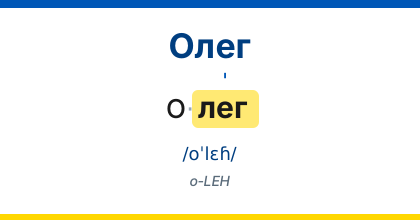
Oleh (Ukrainian: Олег) is a male name of Scandinavian origin meaning «holy», «sacred», «one upon whom blessing rests». It is concise yet carries an image of greatness and sacredness.
The name derives from Old Norse Helgi, meaning «holy, blessed». It was brought to Rus by the Varangians in the 9th–10th centuries. Its most famous bearer was Prince Oleh (Oleh the Wise, †912) — successor to Rurik who, by chronicle tradition, moved the capital to Kyiv and concluded the famous treaty with Byzantium in 911, nailing his shield to the gates of Constantinople. Thanks to its chronicle fame, Oleh became firmly rooted in the Ukrainian onomastic tradition and remains popular today.
From Old Norse Helgi («holy, blessed»); related to the Germanic root *hailaga- («holy, whole»).
Equivalents in other languages: Oleg (Russian, Italian, Georgian, English), Aleh (Belarusian), Oļegs (Latvian), Helge (Swedish, Norwegian, Danish, German, Finnish), Helgi (Icelandic, Old Norse).
Ольо, Олько, Ольчик, Олюсик, Лесь, Лесик, Олежко, Олежик, Олежка, Олежа.
| Nominative | Олег |
| Genitive | Олега |
| Dative | Олегові |
| Accusative | Олега |
| Instrumental | Олегом |
| Locative | Олегові |
| Vocative | Олеже |