
Male Ukrainian name (Степан)
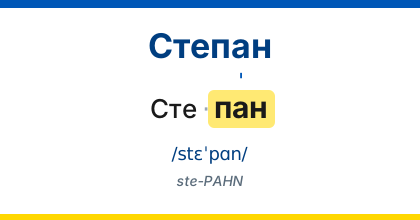
Stepan (Ukrainian: Степан) is a male name of Greek origin meaning «wreath», «crown», «one crowned». An image of a victor crowned with a laurel wreath.
The name derives from Ancient Greek Στέφανος (Stéphanos), meaning «wreath, crown». In Christian tradition Stepan entered through the Apostle Stephen — the first martyr of Christianity (1st century), stoned for preaching in Jerusalem. The Ukrainian form Stepan is native, with the characteristic «e» and a hard ending (in contrast with the Church-Slavonic Stefan). The name was borne by outstanding figures of Ukrainian history, including Stepan Bandera (1909–1959), one of the leaders of the Ukrainian national liberation movement of the 20th century, and the Cossack colonel Stepan Palii.
From Ancient Greek Stéphanos («wreath, crown»); related to the verb stéphō («to encircle, to crown»).
Equivalents in other languages: Stephen / Steven (English), Étienne (French), Esteban (Spanish), Estêvão (Portuguese), Stefano (Italian), Stefan (German, Swedish, Serbian, Romanian), Szczepan / Stefan (Polish), Štěpán (Czech), Štefan (Slovak), Степан (Russian), István (Hungarian).
Стефан, Стецько, Степанонько, Степаночко, Фанко, Стефанонько, Стефаночко, Стефанцбо, Стефаник, Стефко, Стефцьо, Стець, Стьопа, Степа, Степочка, Степушка, Стеша, Стеня, Степанчик, Степаша, Степуша.
| Nominative | Степан |
| Genitive | Степана |
| Dative | Степанові |
| Accusative | Степана |
| Instrumental | Степаном |
| Locative | Степанові |
| Vocative | Степане |